Sunday, 9 July 2023

BOOKS BY CAMPBELL MARTIN


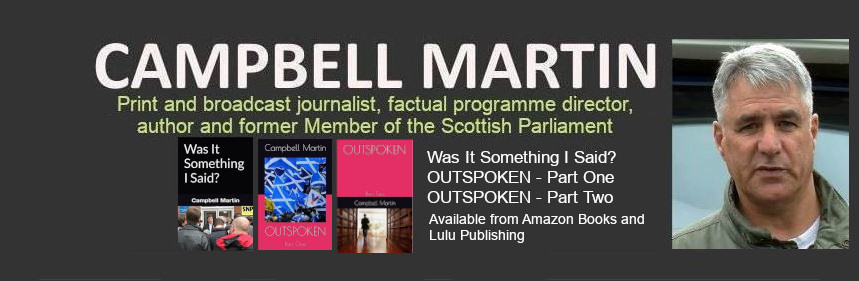
Campbell Martin is the author of three books.

The first, 'Was It Something I Said?', is his autobiography and tells the story of what has been described as “an often troubled life”. Campbell was raised in a working-class family in the west of Scotland and went on to become a Member of the Scottish Parliament. His story recalls his time in the Whips Office of the Scottish National Party, his time as an MSP, and his expulsion from the SNP. Away from politics, Campbell describes issues that have impacted on his life from childhood to the present day.

Campbell's two other books – 'OUTSPOKEN – Part One' and 'OUTSPOKEN – Part Two' – are contemporary accounts of the eventful past ten-years (2013-2023) in Scottish and UK politics, issues affecting society and international affairs. Part One includes the build-up to Scotland's referendum on independence, the vote and the aftermath. Part Two takes us from the SNP's landslide victory at the 2015 UK Election, through subsequent headline-grabbing issues and concludes in July 2023.

The content of the OUTSPOKEN books has been described as “writing that never strays far from controversial”. 

Was It Something I Said?

OUTSPOKEN - Part One 

OUTSPOKEN - Part Two


Wednesday, 22 March 2023

SCOTLAND WITHIN THE UNITED KINGDOM (2007)

 
 Sixteen-years-ago today – March 22, 2007 - this was my final contribution to the Scottish Parliament. It came in a Labour-LibDem Scottish Executive (government) debate on a motion titled 'Scotland in the United Kingdom'. It was supposed to be a platform for Labour and the other British unionist parties to promote Scotland the devolved region of the UK ahead of the 2007 Scottish Parliament Election to be held a few weeks later.
 
My speech features a short intervention from my old pal Margo MacDonald. It should be noted that Margo and I were sitting as Independents: I had been expelled by the SNP and Margo was forced-out of the party under the disastrous 'leadership' of devolutionist John Swinney.
 
Regarding my comment in the last sentence, I never for one moment thought we would still be waiting 16-years-later.
 
-----------------------------
 
Scottish Parliament Official Report
March 22 2007
 
Debate on Scottish Executive Motion 'Scotland in the United Kingdom'
 
Campbell Martin (Ind):
The Minister for Parliamentary Business said that she - I think she meant the Labour Party - came to the Parliament to manage devolution. Well, I did not come here to manage devolution, which partly explains why I now sit as an Independent.
 
Personally, I came here to do my best for the people of Scotland. I do not think we can achieve the best for the people of Scotland in a devolved, constrained, limited Parliament.
 
Margaret Curran (Minister for Parliamentary Business):
Will the member take an intervention?
 
Campbell Martin:
No thanks. We have had three-hundred years of apologists for the British Union. We don't need to hear any more.
 
The people of Scotland have always known their place within the Union, because we have always been told our place within the Union. The Scots' role has been as a labour-force and, in times of war, cannon-fodder.
 
It is not just British political parties or the British establishment that have kept Scotland in its place within the Union; the north-British subsections of the British Labour Party and the other Unionist parties, members of which have spoken in this debate, have conspired to tell the people of Scotland that we are too wee, too poor and too stupid to govern ourselves. That is the reality of Scotland within the United Kingdom.
 
It is not normal for one nation to be governed by another. However, that is the situation we have today. This is only a devolved Parliament, which is answerable to the Westminster Parliament. This Parliament is totally subservient to the Parliament in London.
 
We need independence because only with independence can we deal with the bread-and-butter issues that affect Scots every day of their lives. The Unionist parties have told us they want the election to be about the bread-and-butter issues, not about constitutional change. I argue that we need constitutional change to give us the full powers and full resources we require to deal with the problems - the bread-and-butter issues - affecting Scots today. Without the powers that come only with independence, we will continue to target initiatives at symptoms, rather than at the actual problems.
 
We know that Unionist political parties do not always tell the truth when they are talking about the constitution and independence. Back when the constitutional reality was a Scotland governed directly from London, we were told that devolution would be a leap in the dark and probably would be the end of civilisation as we knew it. That, clearly, was not true. Now we are told that, if we move to independence, it will be a leap in the dark and probably the end of civilisation as we know it. That, too, is untrue. Then again, as I said, Unionist parties have a history of not telling the truth.
 
Charlie Gordon referred to the sweeping-to-power of the Wilson Government in the mid-1970s and how great that was. I remember that, too. I was a teenager in the mid-1970s, and I remember being told by the then Labour Government that Scotland was an economic basket-case and that we couldn't stand on our own two feet and govern ourselves.
 
Margo MacDonald (Ind):
Will Campbell give way?
 
Campbell Martin:
Of course.
 
Margo MacDonald:
I was not at school in the mid-1970s; I was in Westminster. I was told, privately, by the Chancellor of the Exchequer a few years later that Scotland was not, in fact, an economic basket-case; that my case was watertight, but that he would oppose me every inch of the way. That was Denis Healey.
 
Campbell Martin:
Yet Denis Healey was the very man who said, publicly, that we were an economic basket-case and could not stand on our own two feet. As I said, unionist politicians and political parties do not always tell the truth when they are talking about the constitution.
 
Dr Gavin McCrone supplied a report to the Labour Government at that time. The Labour Government had told us that Scotland was an economic basket-case and that we were too wee, too poor and too stupid, but, at the same time, McCrone was telling them that Scotland could quickly become one of Europe's strongest economies with embarrassingly large surpluses. McCrone told the Labour Government that oil revenue would: "transform Scotland into a country with a substantial and chronic surplus." I imagine, from a Unionist perspective, such Scottish wealth would result from a 'plague' of oil.
So, British Unionist parties have a track record of not telling the truth. The people of Scotland would vote for independence if Unionist politicians did not lie to them. Those politicians know they are lying because they are intelligent people; well, relatively intelligent people.
 
Why is Scotland - alone among all the nations in the world - unable to stand on its own two feet or to manage its affairs better in its people's interests? Why do Unionist political parties have to do Scotland down and scare the people of Scotland away from their democratic right to retake their independence?
 
Roll on the day - it is coming, and members know it - when the people of Scotland retake their independence for the benefit of all the people of Scotland.
 
----------------------
 
Books by Campbell Martin:
 

Sunday, 19 February 2023

ANYONE FANCY A BY-ELECTION IN GLASGOW SOUTHSIDE?

Just a thought: what if Nicola Sturgeon didn't put her feet up and settle into the back-benches at Holyrood until the next Scottish Parliament Election in three-years time? What if, instead, Nicola Sturgeon stood-down as MSP for the Glasgow Southside constituency?

If the outgoing First Minister took that course of action, there would be a by-election to select a new MSP for the Glasgow constituency. At the 2021 Scottish Parliament Election, the Labour candidate in Glasgow Southside was Anas Sarwar. A candidate cannot contest an election to the Scottish Parliament if they already hold a seat at Holyrood [Scotland Act 1998: Section 9]. So, if Sarwar was to contest a by-election in Glasgow Southside, he would first have to stand-down as a Regional List MSP for Glasgow.

Of course, Sarwar might choose not to be the Labour candidate at such a by-election, but what would that say about how he thinks his party is likely to perform in Scotland? Would the leader of the Labour Party in Scotland really allow the country to see that he, personally, was feart to fight the SNP in a one-off by-election?

So, if Nicola Sturgeon stood down as an MSP, creating a by-election in Glasgow Southside, the pressure would be on Anas Sarwar to lead from the front for Labour and to contest the seat. Would Sarwar have the courage to do that, given he would have to stand-down from his current position as a List MSP for Glasgow and, if he didn't win the by-election, he would be out of the Scottish Parliament until 2026? On the plus side for Anas Sarwar, though, is the chance he could be the Labour candidate who took the seat of the former SNP First Minister.

Just for background: the first Scottish Parliament constituency by-election was in March 2000, just 10-months after the first full elections in 1999. Labour MSP Ian Welsh stood-down in the Ayr constituency. At the 1999 Election, the Tory candidate was Phil Gallie, who had previously been the MP for Ayr. Labour's majority was just 25. Despite this, Gallie chose not to fight the by-election, which would have required him to stand-down as a List MSP for South of Scotland. In the 2000 by-election, the Tories took Ayr with Labour falling to third behind the SNP.

In 2006, on the death of SNP MSP Margaret Ewing, there was a by-election in the Moray constituency. Richard Lochhead for the SNP and Mary Scanlon for the Tories were both sitting List MSPs representing the North East Scotland Region. Both stood-down to contest the constituency by-election. Richard Lochhead won for the SNP, while Mary Scanlon finished second and was out of parliament until the 2007 Scottish Parliament Election when she was again returned as a Regional List MSP for North East Scotland.

So, if Nicola Sturgeon stood-down as an MSP and created a by-election in the Glasgow Southside constituency, would Anas Sarwar be prepared to stand-down as a Regional List MSP for Glasgow to contest the constituency seat, or would he bottle-it, remain as a List MSP and send the message that he doesn't think Labour would win with him as the candidate?

Ultimately, a decision on whether or not to call a by-election in Glasgow Southside lies with Nicola Sturgeon and the SNP. If they haven't considered the position a by-election would place Anas Sarwar, they should have. Of course the SNP would have to consider that they might lose a by-election. However, given that the SNP majority in Glasgow Southside at the 2021 Scottish Parliament Election was 9,465, surely the party could not throw away such a massive electoral advantage. Actually, given the state of today's gender-obsessed SNP, they might want to sit tight, even if that lets Anas Sarwar off the by-election hook.

Thursday, 24 June 2021

COUNCILLORS IGNORE WARNINGS OVER PROPOSED SCHOOL SITE

Labour, SNP and Tory councillors joined together at Wednesday's meeting of North Ayrshire Council (June 23) to throw-out a proposal from Saltcoats Independent councillor Ronnie McNicol, which called for the local authority to stop plans for new schools and a leisure centre to be built on the former Shell-Mex oil and bitumen refinery in Ardrossan.

A report compiled by Council officers, and which included the opinions of Envirocentre, the local authority's contractor for the 'North Shore' site in Ardrossan, was presented, with councillors asked to “note” the findings. However, in an amendment, Cllr McNicol moved that officers be instructed “not to proceed with the plan to build new schools and leisure facilities on toxic, contaminated land at the former Shell-Mex site in Ardrossan”.

In addition, Ronnie McNicol asked councillors to support his call that officers also should examine if the land at the 'North Shore' site could ever be safely used “for any purpose”, such as an environmental beach-park and walkway. The Saltcoats councillor further argued that officers should “investigate why Shell was allowed to walk away from Ardrossan, leaving behind a large area of highly toxic, contaminated land”.

The Council report supported the opinion of Envirocentre that the toxic land could be cleaned sufficiently to allow for schools and a leisure facility to be built on it and used by local people, including school pupils aged 5-to-18.

However, speaking to his amendment, Cllr McNicol pointed out that Envirocentre, themselves, said their proposals to clean the land would only “limit risk to human health”. The Independent councillor said, “Note it does not say it will remove risk to human health. Why not build schools on a site that does not present a risk to human health? Even a limited risk to human health presents the chance that, in the future, young people, teachers and other facility users could become unwell, possibly seriously unwell. Why take that chance when there are numerous other, and safe, sites that could be used?”

Reading from the Council/Envirocentre report, Cllr McNicol referred to a long-list of contaminants in the soil of the 'North Shore' site, including: heavy metals, asbestos, arsenic, cadmium, chromium, copper, lead, mercury, selenium and zinc.

Addressing councillors, Ronnie McNicol said, “On Arsenic, the World Health Organisation states: 'Early childhood exposure to Arsenic has been linked to negative impacts on cognitive development and increased deaths in young adults'.

“Of Asbestos, the Health & Safety Executive says: 'When materials that contain asbestos are disturbed or damaged, fibres are released into the air. When these fibres are inhaled they can cause serious diseases. These diseases will not affect you immediately; they often take a long time to develop, but once diagnosed, it is often too late to do anything'.

“NHS Inform says of Lead: 'Exposure to Lead can be harmful especially to unborn babies and young children. Children absorb more lead than adults due to their growing bones and other organs', with a prominent symptom of Lead poisoning in children being 'developmental delay and learning difficulties'.

“Of Mercury, the World Health Organisation says: 'Exposure to mercury – even small amounts – may cause serious health problems, and is a threat to the development of children'.”

The long-serving councillor continued, “Membranes are to be laid across the site, in the hope that this will stop contaminants from reaching the surface. Then, environmental capping will be applied to certain areas. Environmental capping is laying down topsoil to a general depth of 60cm or just 2ft of safe soil.

“Again, despite claims that contaminants will be removed, the report states that the footprint of all buildings will have hydrocarbon and ground gas resistant membranes installed, while water supply pipes and utility service connections will require additional protection – all to try and minimise the impact of 'residual contaminants'. So, all contaminants are not expected to be removed, and yet the Council proposes to build schools on this land.”

Cllr McNicol concluded, “There are numerous other sites – safe sites – in the local area that could be used for new schools and leisure facilities. This proposal for the former Shell Mex site should not go ahead. It is madness.

“All I can say to councillors who might be minded to support building schools on a toxic, contaminated site is: I hope you are right that the site can be cleaned. I hope you are right, because if you are not right, and in the future young people and teachers become ill, then responsibility for that will be on your heads.”

Despite Cllr McNicol's chilling warnings of the contaminants at the proposed school site, and how they present specific dangers to young people, all Labour and SNP councillors present at the meeting voted against the amendment and for the report to continue with proposals to build new schools and a leisure centre. All-but-one of the Tory Group also voted to ignore Ronnie McNicol's warnings.

Cllr McNicol's amendment received support from his fellow Independent councillors, Robert Barr, Ian Murdoch, Donald L Reid, and one Tory, John Glover.